Supreme Bishop Digby
Stranger in a Strange LandSupreme Bishop Digby is the public head of the Fosterite church after Archangel Foster’s death, a leader whose authority is staged through spectacle and whose institution combines religious immunity, political power, and carefully managed recruitment. His encounter with Mike brings the limits of that authority into view: Digby seeks to reach him privately, but Mike does not answer his welcome, and the two do not complete the course Digby had planned. Later, Digby is announced as bodily translated to Heaven and promoted to Archangel; in that new position, he is told he cannot interfere with Mike, whom the Martians still need.
Office and Public Persona
As Supreme Bishop, Digby occupies the highest visible office in a church whose leadership can carry weight beyond its congregation. Jubal warns Jill that a church in this society is effectively exempt from taxation and many forms of public oversight, and that political influence further protects it. His concern is specific: if the sincere Mike is converted and makes a will favoring the church, his fortune could pass into Fosterite hands. Digby’s office is therefore not merely ceremonial; it stands at the meeting point of spiritual persuasion, organizational privilege, and material stakes.
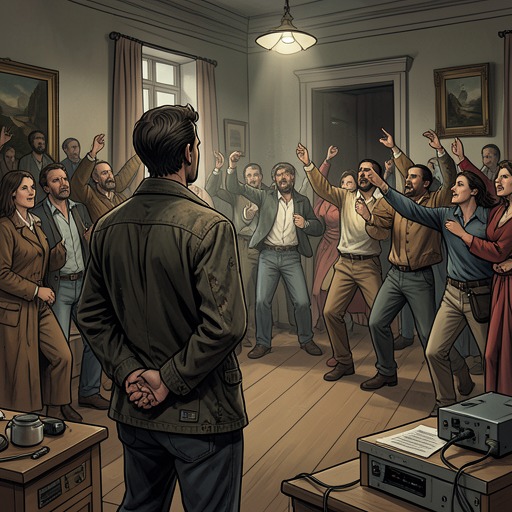
The church presents its power in public as a carefully produced spectacle. At a gathering, the lights go down and a brilliant, apparently source-less radiance picks out Digby behind the altar. He leads an ecstatic congregation, acknowledges the crowd, and then turns his attention to two women near the altar before continuing toward the pulpit. The scene makes his authority visible as performance: lighting, crowd response, stage movement, and the microphone all help frame the bishop as the center of a collective religious event.
Digby’s public appearance is not his only register. When he meets Mike, Jill, and Jubal privately, he has removed his formal vestments and wears flowing robes. He greets Mike warmly, invokes Foster’s protection, and welcomes him to the church. Jubal notices Digby’s short stature and compares his ready smile and manner to a used-car salesman; he also sees a resemblance to Simon Magus, a man Jubal had found likable. The comparison registers both Digby’s charm and Jubal’s guarded recognition of a practiced, persuasive personality.
The Attempt to Reach Mike
The private meeting follows a conspicuous public display. Senator Boone ushers the visitors through a small elevator concealed in the tunnel’s decorations to a parlor in Digby’s private apartments, where Digby receives them after showering. He tells Mike that Archangel Foster is watching over him and that he should feel at home in the Lord’s House. Mike does not answer. Digby’s welcome is thus met not with agreement or argument but with silence, leaving the hoped-for connection unconfirmed.
Digby also speaks to Jill, addressing her as a fellow traveler despite her not belonging to the Fosterite church. He shows knowledge of her background and expresses respect for her calling, invoking Foster’s teaching that physical well-being should be cared for so the soul can seek light. The courtesy helps Digby present the church as hospitable even to an outsider. But Jill soon suspects that the group has been deliberately maneuvered so Digby can work on Mike alone. Jubal agrees with her assessment, and Jill prepares to interrupt and tell Mike it is time to leave. Their response exposes the tension beneath Digby’s gracious manner: the private audience may be a recruitment opportunity, and Mike’s companions do not intend to leave him to it unguarded.
Jubal’s broader warning explains why the encounter matters. He believes Fosterites are sincere and that Mike is especially susceptible to sincerity. In his view, Digby’s church could first convert Mike and then gain access to his wealth through a will. The legal protections afforded to churches make this prospect difficult to block once Mike chooses to give. Digby’s effort to welcome Mike therefore carries stakes beyond personal belief: it takes place within an institution capable of turning religious commitment into durable organizational and financial power.
Fosterite Organization and Its Inheritance
Digby leads a movement shaped by Foster’s ability to match religious appeal to the culture around him. The narrative describes a society divided between puritanical public rules and more permissive private behavior, alongside a pattern in which established religious forms coexist with highly emotional revivals. Foster’s personal magnetism and his ability to organize a movement allowed the church to expand where earlier efforts had failed. The account emphasizes that Foster borrowed methods and structures from a range of institutions, adapting them to a religious enterprise presented as a return to primitive Christianity.
The church is layered. An outer congregation lets seekers participate without immediate full membership; a middle church presents itself publicly as the New Revelation, offering saved members communal and economic benefits while making continued support of the institution central to belonging. Beyond these is an inner body of dedicated leaders, keepers of records and keys, and policy-makers. Its members are described as reborn, assured of salvation, and the only candidates for direct admission to Heaven. This hierarchy helps clarify the position Digby inherits: he is not simply a preacher addressing a crowd but the leading figure in a structured system with differentiated access, responsibilities, and promises.
The organization’s public religious language also accompanies political and legal resilience. The narrative recounts how Fosterites could mobilize members from other places when a community tried to suppress a local movement, and how prosecutions framed as persecution were difficult to sustain. Jubal’s explanation of church immunity supplies the legal dimension of the same institutional strength. In this context, Digby’s private approach to Mike belongs to a larger organizational pattern: welcoming a potential convert can strengthen a movement that already knows how to convert devotion into scale and protection.
Promotion and Conflict After Death
After Mike has interrupted Digby’s work, the Fosterite bishops announce the church’s second Major Miracle: Digby has been translated bodily to Heaven and promoted to Archangel, ranking after Foster. The announcement of the new Supreme Bishop, Huey Short, had been delayed until the elevation was confirmed; Short is described as a compromise accepted by the Boone faction after repeated casting of lots. Digby’s promotion is therefore both a religious proclamation and a transfer of leadership within a divided organization.
The promotion does not satisfy Digby. In conversation with Foster, he complains that Mike interrupted him with his work half finished and predicts that Short will mishandle matters. Foster answers with patience, telling him that as an angel he should put recriminations aside. He reminds Digby that he too was once a poor leader before his promotion, and argues that the new Supreme Bishop may likewise improve in office. The exchange turns the church’s public miracle into a private dispute about unfinished work, succession, and the difference between present ability and the status conferred by promotion.
Digby asks to act against Mike, but Foster refuses. He says Digby cannot touch him and should not have tried in the first place; a request for a miracle would be rejected because Digby does not understand the system. The decisive limit is that the Martians have their own order, and they still need Mike. Foster presents the universe as containing different arrangements rather than one authority able to override them all. Digby’s elevation gives him a new rank, but not the power to complete the project he had begun. The reversal defines his arc: the leader who sought a private opportunity to influence Mike becomes an Archangel expressly barred from interfering with him.